From January 1, 2026, Russia moves bookmakers to a single federal gambling business tax. The rate for bookmakers is 7% of the difference between accepted bets and paid winnings. Yekaterinburg players can still find no-deposit freebets, but the legal tax landscape around those bonuses has changed. Offshore platforms and licensed operators now face different obligations.
Tax on bookmakers’ profits after January 2026
Chapter 25.5 of the Russian Tax Code introduces a single tax on the gambling business from January 1, 2026. For bookmakers, the tax base is gross income minus winnings paid to players. The rate is 7%. This replaces the previous mix of regional gambling taxes. Fixed rates remain at 250,000 rubles for each gaming table and 15,000 rubles for each slot machine. Bookmakers must register equipment five days before installation.
The tax on bookmakers’ profits works as a turnover-adjusted levy rather than a classic corporate income tax. If a bookmaker accepts 100 million rubles in bets and pays out 93 million rubles in winnings, the taxable base is 7 million rubles. At 7%, the gambling business tax amounts to 490,000 rubles.
If total winnings paid out in a reporting period stay below 15,000 rubles, the tax base is zero. This rule can also affect small promotional campaigns, although the exact treatment depends on the applicable tax rules.
What players owe on withdrawals
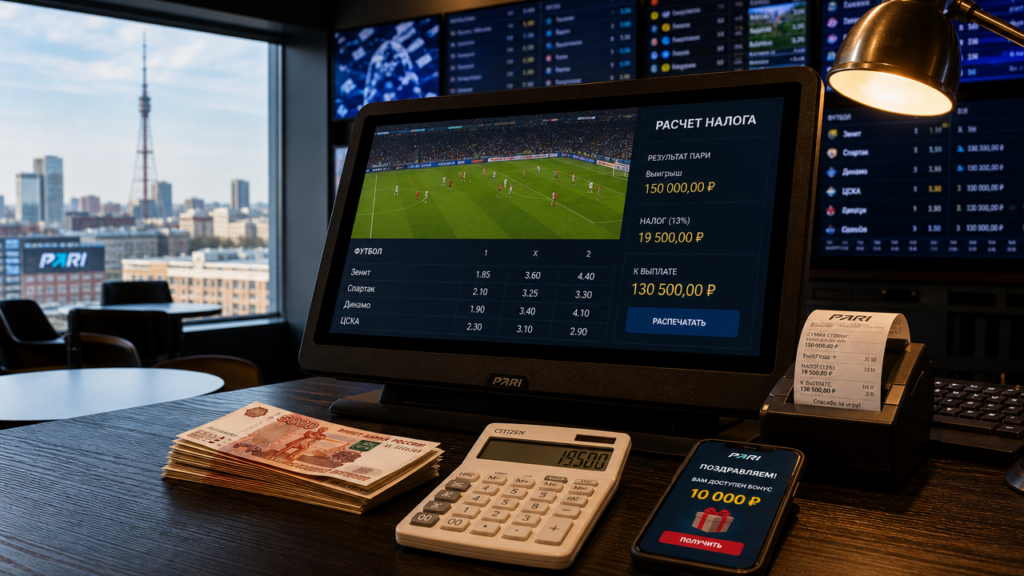
Bookmakers are no longer exempt from withholding personal income tax on player winnings. The tax base is the profit calculated when a player withdraws money, not the total withdrawal amount. Finance authorities have stated that the tax should apply only to profit. Russian bookmakers act as tax agents and may withhold 13% immediately. Some operators cover the tax at first and recover it from the player later.
A concrete example makes this clearer. A player deposits 10,000 rubles and later withdraws 13,000 rubles. The profit is 3,000 rubles, and the 13% tax is 390 rubles. The bookmaker can withhold that amount from the withdrawal or pay it internally and deduct it from the player later. Freebet winnings may fall under the 15,000-ruble threshold, but the bookmaker’s wagering rules still apply before any withdrawal.
International offshore platforms and the largest bookmaker in Russia
An international crypto-oriented offshore platform launched in 2016 is often discussed as a major platform with Russian-speaking users. It reports more than 100 million users and offers sports betting, casino games, and virtual sports with a minimalist interface and multilingual support. It also has Web3 development plans. Its reputation is linked to dispute resolution and bonuses.
The platform is not a legal operator in Russia. Russian authorities block it, and its organizers face international wanted lists and asset seizures. In November 2024, a data breach exposed records for about 100 million users. The largest bookmaker in Russia among licensed operators cannot be an offshore platform without a Russian license.
Among licensed operators, comparisons depend on the metric used. September 2026 offers included bonuses of up to 15,000 rubles without a deposit and bonuses of up to 10,000 rubles that required a deposit. These offers did not have the same international scale as the offshore platform, but they were presented as part of the Russian betting market.
Bookmakers with no-deposit freebet in Yekaterinburg
The following no-deposit freebets were listed for September 2026 and could be claimed online from Yekaterinburg through the relevant operators’ legal platforms.
- One operator offered 1,000 rubles without a deposit through promo code STV1000.
- Another offered a 500-ruble freebet without a deposit through promo code STV500, with a separate game awarding levels from 500 to 1,000 rubles.
- One offer provided up to 15,000 rubles as a no-deposit bonus and appeared among the top September 2026 offers through code VBRSPORT.
- Another operator offered 3,000 rubles without a deposit through VBRSPORT and returned a 100-ruble freebet series.
- Only three of the fifteen operators in the VBRSPORT campaign provided true no-deposit bonuses.
- One offer was divided into four separate 500-ruble freebets.
The offers came from separate campaigns with different codes and conditions. Most registration bonuses required a deposit, while only a small number were available without one.
How to claim no-deposit offers in Yekaterinburg
Players should follow the registration instructions for the relevant offer, enter the correct promo code, complete identity verification, and review the bonus terms before placing a bet. Participants in the 1,000-ruble offer enter STV1000, while participants in the 500-ruble offer enter STV500. Other credits may appear after verification or after meeting additional campaign conditions.
Withdrawal of freebet winnings usually depends on turnover requirements. A 1,000-ruble freebet is not 1,000 rubles in cash. Bookmakers often require playthrough at minimum odds before profit can be withdrawn. If the platform states that total winnings below 15,000 rubles are not taxed, that threshold does not cancel the wagering condition. Players should check the minimum odds and the freebet expiration date before placing the first bet.
What the 2026 shift means for Yekaterinburg bettors
A legal bookmaker office in Yekaterinburg should show a Russian license and offer registration through the centralized betting accounting system. Offshore platforms without a Russian license do not meet this test. The new 7% tax on bookmakers’ profits may push operators to adjust odds, reduce bonus budgets, or pass withholding costs to players. In 2026, a freebet can serve as a low-risk way to test a platform, but the operator’s tax and withdrawal policy matters more than the bonus amount.
The no-deposit market in Yekaterinburg remains small. Most registration bonuses still require a deposit, and the few true no-deposit offers come with strict verification and wagering rules. The safest approach is to use a legal Russian bookmaker, claim one no-deposit freebet, and treat any winnings as a test of the withdrawal process rather than guaranteed income.